
What's In The Bill
The ECE Profession Bill is based on the recommendations of the Office of Professional Regulation (OPR),
which are rooted in recommendations from Vermont's early childhood educator workforce.
Who Is Impacted by the
ECE Profession Bill
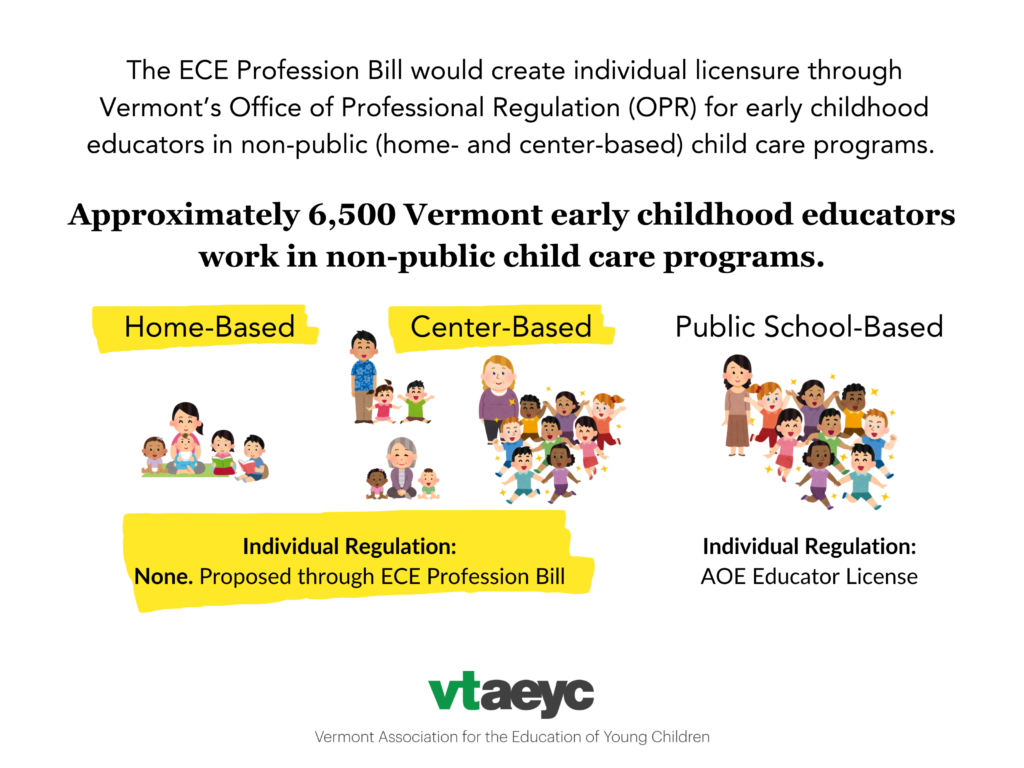
Young children learn in various settings. Vermont’s Child Development Division (CDD) regulates these settings, which employ more than 8,000 people. The ECE Profession Bill would create a license to practice through the Office of Professional Regulation (OPR) for early childhood educators working in regulated family child care home programs and center-based programs. This includes about 6,500 educators.
Who is not impacted: People providing friend and family care—caring for up to two families’ children in addition to their own—are not subject to regulation. People working in CDD-regulated afterschool programs and in Agency of Education (AOE)-regulated public school programs are also exempt from needing an OPR license to practice. And early childhood educators already licensed through AOE would be exempt from needing an OPR license.
A Clear, Flexible, Accountable Licensure System
The ECE Profession Bill creates a governing board primarily made up of working early childhood educators. It creates a licensure system with titles, designations, and standards aligned with recommendations for a national profession. As an early childhood educator’s qualifications and skills increase, their responsibilities and compensation would also increase.
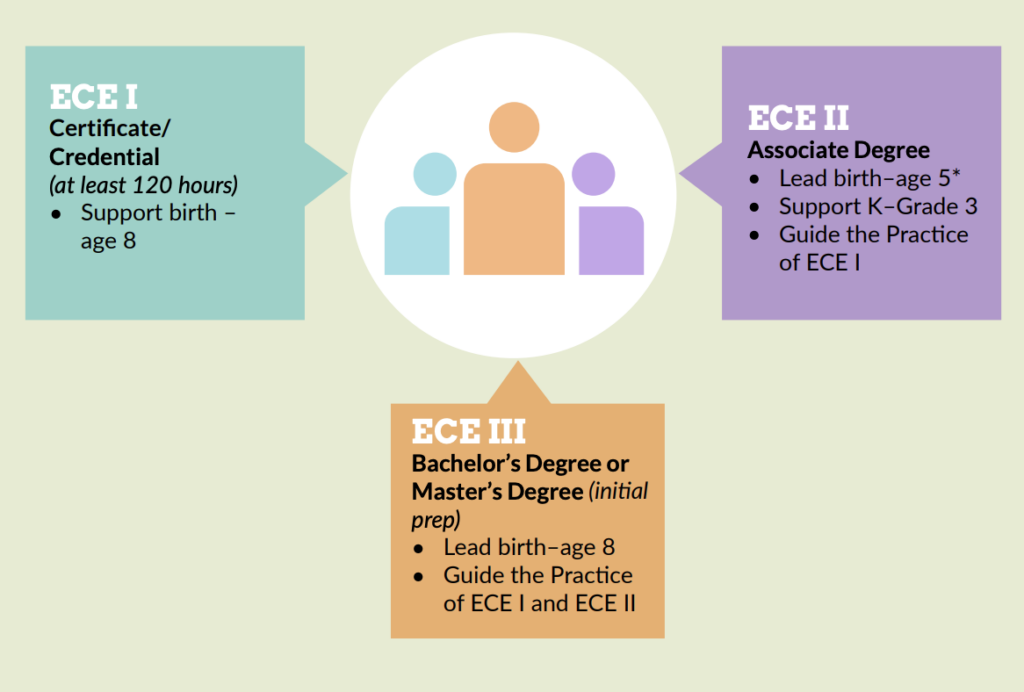
There are three designations: Early Childhood Educator (ECE) I, ECE II, and ECE III.
- ECE I: $
Preparation program of minimum 120 clock hours - ECE II: $$
Associate degree - ECE III: $$$
Bachelor’s degree or initial Master’s degree
Like the nursing profession, these designations reflect different levels of preparation and responsibility, and can be used across settings and systems to understand an individual’s qualifications to support, lead, or guide.
Image: Detail of “One Profession, Three Designations,” infographic, The Unifying Framework for the Early Childhood Education Profession, p. 29
First The Bill, Then The Details
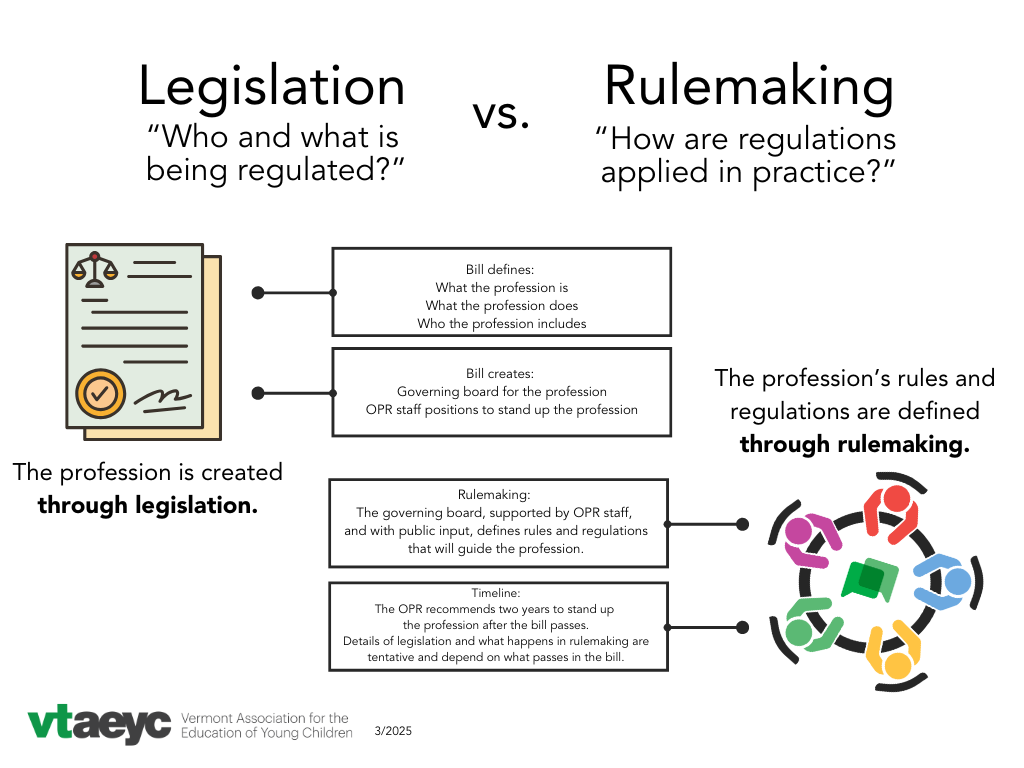
The ECE Profession Bill would define what the profession is, what it does, and who it includes.
If the bill becomes law, the rulemaking process will define the rules and regulations that will guide the profession. This process would take about two years and include input from early childhood educators. It would be led by a governing board that includes early childhood educators representing every designation, supported by staff in the Office of Professional Regulation (OPR).
There are a lot of details that may not be included in legislation because it makes more sense to work them out in rulemaking.
Clear Paths and Transition Supports
The ECE Profession is designed for the future.
Today’s ECEs must have time and resources to get there—and get credit for the expertise they already have.
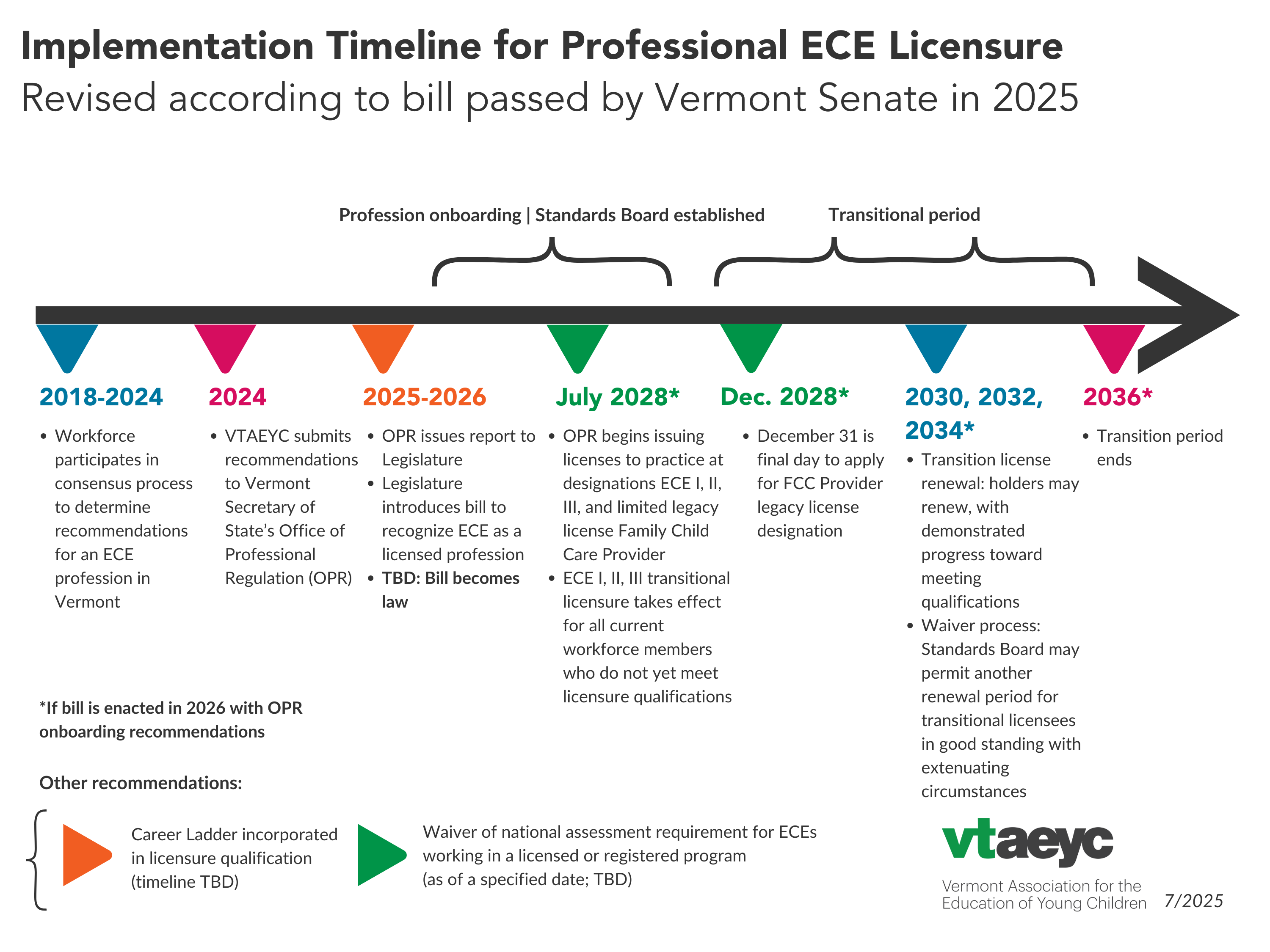
The bill includes provisions to support every member of the current workforce. Renewable transition licenses mean educators can keep working while they earn new credentials over time. A legacy license for family child care home owners effectively “grandfathers” regulated FCCH program owners into the new system.
The bill includes additional provisions to help our current workforce qualify for ECE licensure with the skills and experience they already have.
In the meantime, higher ed and preparation programs are aligned with the standards and competencies recommended for the profession, and students are already earning credentials aligned with ECE I, II, and III.
What's Happening In Vermont
Our pledge is to keep our early childhood education workforce informed about the ECE Profession Bill—and give you opportunities to have your voice heard.

ECE Profession Bill
The ECE Profession Bill introduced in 2026 as S.206 in the Vermont Senate includes recruitment and retention provisions Vermont early childhood educators advocated for:
- Expanding ECE II and ECE III qualification to include degrees in related fields OR in unrelated fields with at least 21 credits in ECE core competency areas
- Introducing a limited, legacy "FCCH Provider" license option
- Extending the transition period to 8 years

OPR Recommendations
In 2025, Vermont’s Office of Professional Regulation (OPR) submitted a Sunrise Review Report to lawmakers, prompted by the recommendations from Vermont’s ECE workforce, that recommends establishing licensure for early childhood educators in non-public settings. OPR concluded ECE licensure will benefit:
2026 Legislative Recap
The Vermont Senate passed the ECE Profession Bill with overwhelming bipartisan support. The 2026 session ended before the House could fully address the bill. Key House committees pledged to take it up in 2027.
Early childhood educator advocacy accomplished a great deal during a challenging legislative session. During 2026, lawmakers faced several other urgent issues, including public education transformation—which included significant work to preserve Universal Pre-K in its current structure.
Testimony, letters, emails, and calls from early childhood educators helped secure bipartisan support for the ECE Profession Bill in the Senate and helped build understanding among House committees. This work positions the bill for continued progress in 2027.
National Recommendations and Leadership
The workforce-led consensus process that led to Vermont’s ECE Profession Bill is modeled on the nationwide process that led to the Unifying Framework for the Early Childhood Education Profession.
The Unifying Framework
The Unifying Framework makes recommendations that advance a unified, diverse, equitable, and effective national early childhood education profession. It is the core document of our project in Vermont. Our workforce overwhelmingly agreed with its recommendations.
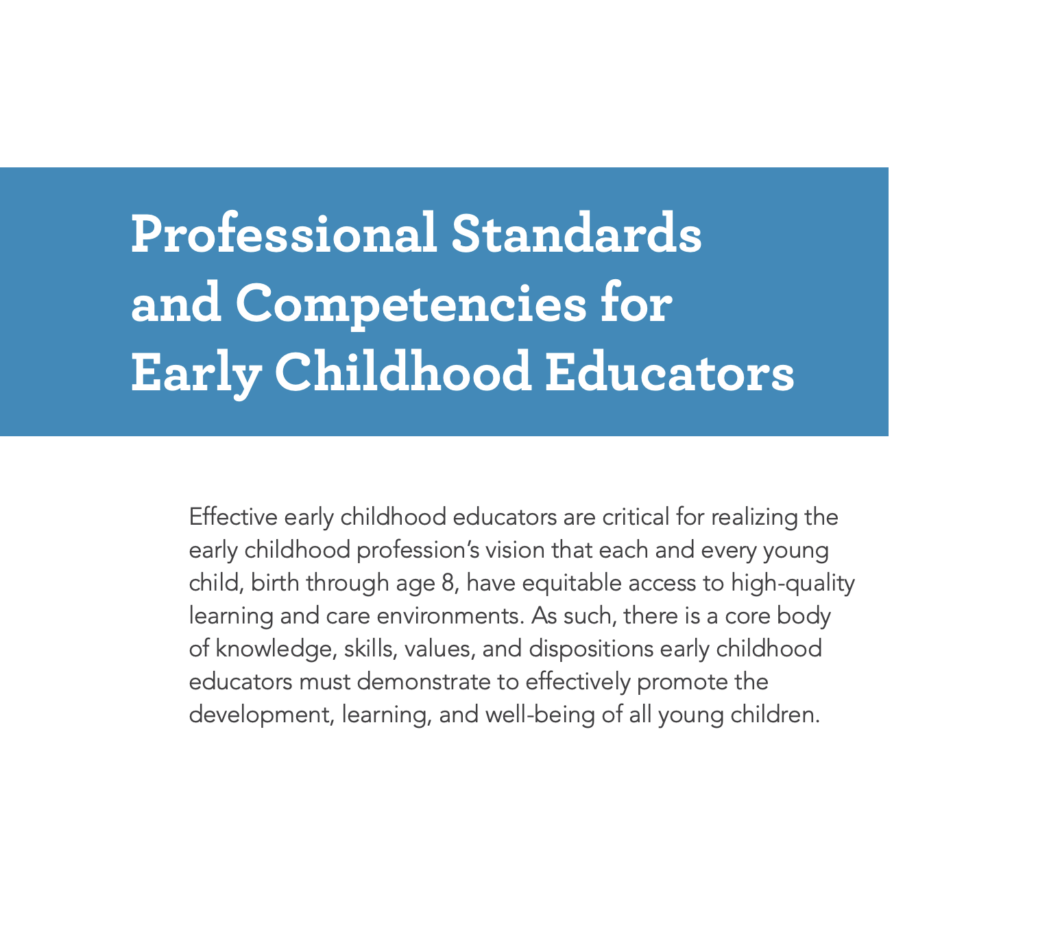
NAEYC's Professional Standards and Competencies
The Professional Standards and Competencies will serve as standards for the future national ECE Profession.

The Commission on Professional Excellence in ECE
The Commission on Professional Excellence in Early Childhood Education launched in 2023 to serve as the professional governance body that advances the implementation of Unifying Framework recommendations nationwide.
We work closely with the Commission. It recognizes Vermont as one of the states leading on implementing recommendations.
I Want To Advocate!
The voices of early childhood educators are critical to strengthening and passing the ECE Profession Bill.